

Summary
Guest refund requests cost far more than the booking itself. See the staff hours, guest experience, and revenue that "just this once" quietly drains.
What “just this once” is really costing your vacation rental business.
Guest Refund Requests Always Start with a Phone Call
A guest calls three days before arrival. There has been a family emergency, the trip is off, and they are well outside the cancellation window. They are polite. The story is real. They ask for a full refund.
Your reservations agent wants to help. They are outside of their cancellation window. Someone has to make a call and, whichever way it goes, someone ends the conversation unhappy.
For most vacation rental operators, this is no longer an occasional edge case. Guest refund requests have become a weekly line of work, and handling them one at a time costs far more than the refunds themselves.
The Visible Cost: A Booking You Probably Cannot Replace
The obvious cost is the money that leaves the account. What is less obvious is how hard that money is to replace once it is gone.
Booking windows have compressed. Guests commit later, shop harder, and choose the listing that gives them a way out. A cancellation released back to the calendar seventy-two hours before check-in is competing against every other last-minute vacancy in the market, usually on price. Even when the dates do refill, they often refill lower, and the difference never shows up on a report as a loss. It simply shows up as a smaller month.
In peak season the math gets sharper. A single late cancellation on a premium week can erase the margin earned on several clean stays, which is exactly the exposure revenue leaders are being asked to explain.
Wondering how other operators keep these decisions off their reservations team? Explore your options.
The Hidden Cost: Hours for Which Nobody Invoices
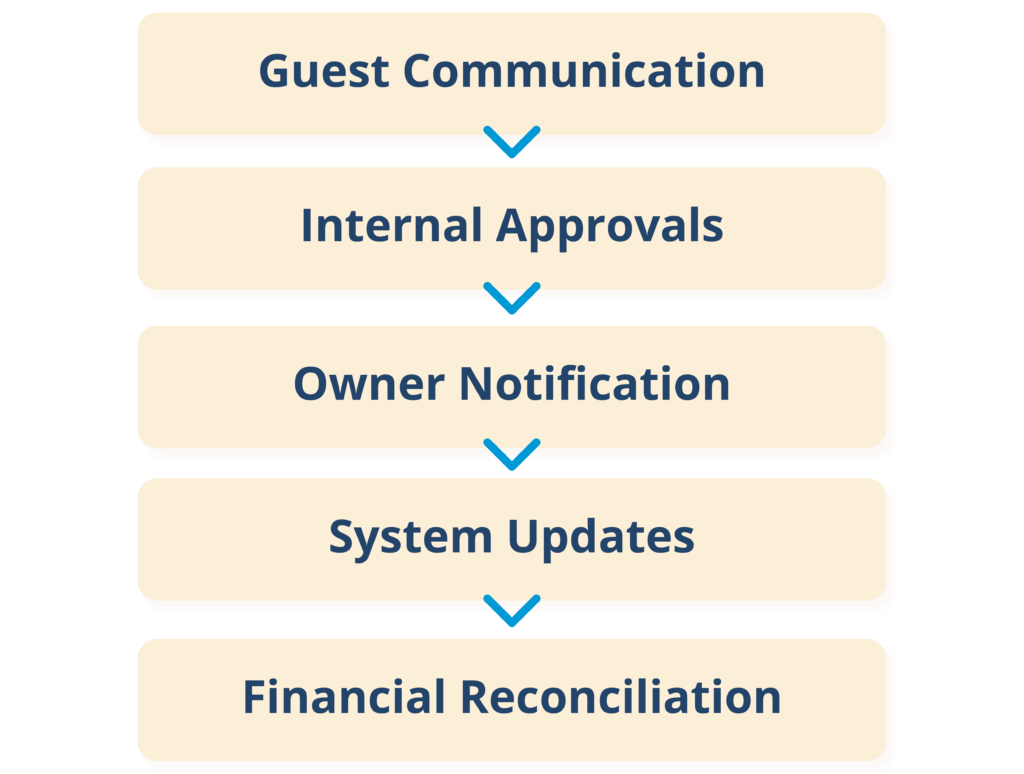
A guest refund request almost never ends with a single email. One exception typically travels through:
- Two or three rounds of guest messages, often emotional and rarely quick
- An internal approval, because the agent cannot authorize the exception alone
- A homeowner notification, which is its own conversation
- Reservation, rate, and channel adjustments so the calendar reflects reality
- Accounting reconciliation, trust accounting included, before the month closes
What looked like a five-minute decision consumes hours of skilled labor, spread across the people you least want pulled off revenue-generating work. Multiply that by the number of exceptions your team fields in a season and the staffing cost of your cancellation policy becomes visible for the first time.
There is a morale cost underneath it. Teams that spend their week negotiating refunds stop feeling like hosts and start feeling like a claims department.
Caught Between the Guest Satisfaction and a Cancellation policy.
Every refund decision asks a property manager to serve two people whose interests point in opposite directions. Owners expect policies to be enforced and income to be defended. Guests expect empathy, flexibility, and a human response to a genuinely bad week. Handled badly, a single exception damages both relationships at once: the owner sees a manager who gave away their revenue, and the guest still leaves a three-star review about how long the decision took.
Most teams end up improvising a middle path. Partial refunds. Credits for a future stay. Fee waivers that quietly come out of management revenue rather than owner revenue. None of it is written down, which means the policy your business actually runs on is whoever answered the phone that day.
“The policy your business actually runs on is whoever answered the phone that day.”

What Guest Behavior Is Telling You
The pressure behind these guest refund requests is not a customer service problem. It is a market signal, the numbers are consistent, and here’s what it means for your calendar:
- 75% of travelers prefer flexible cancellation when deciding where to book ~Expedia Group Research
- 3x higher conversion on listings that carry flexible cancellation policies ~Airbnb Partner Data
- +30% ADR uplift reported on OTA listings offering flexible cancellation ~Operator Data
- 30% fuller booking calendars where flexible policies are in place ~ VRNation Owner Retention Panel, 2025
Curious how your own cancellation strategy measures up against those numbers? Explore your options.
Guests are not asking for exceptions because your policy is unclear. They are asking because the rest of the travel market, hotels and airlines included, has trained them to expect a way out. A strict policy does not stop that expectation. It just moves the conversation from the booking page to your phone line, three days before arrival.
Building a Better Default
The goal is not to deny legitimate guest hardship. It is to stop making every hard week a three-way trade between guest satisfaction, owner satisfaction, and revenue. That starts with three practical moves.
- Write down the exception rule you are already following. If your team grants partial refunds at a certain threshold, make it policy, publish it internally, and let agents resolve those cases without an approval chain. Undocumented discretion is what turns a ten-minute case into a three-day one.
- Track what exceptions actually cost. Log every refund request with the reason, the dollar value, whether the dates refilled, and roughly how much staff time it consumed. Within one season you will have the number that ends the debate about whether your cancellation strategy is working.
- Move the risk off the relationship. This is where cancellation protection changes the shape of the problem. When coverage is attached to the reservation at the time of booking, a covered cancellation is no longer a negotiation between a manager, a guest, and an owner. It is a defined outcome everyone agreed to up front.
That is the premise behind Booking Guardian from RentalGuardian.com by Inhabit. Coverage attaches automatically to qualifying reservations through a native integration with your reservation platform, so there is no manual step for your team. When a covered guest cancels, Booking Guardian pays your property management company directly, which keeps the owner statement whole and the forward revenue picture predictable. Booking Guardian+ extends eligible cancellation coverage from 60 days out to 3 days before check-in, and deductibles may be waived when a replacement reservation meets qualifying rebooking thresholds.
The practical effect is not that refunds disappear. It is that the refund conversation stops being a judgment call your team has to win.
If protecting the booking sounds better than debating it, explore your options with the RentalGuardian team.
The True Price of “Just This Once”
Guest refund requests are not only financial decisions. They are operational decisions, relationship decisions, and, eventually, owner retention decisions. Each one spends money, hours, and trust, and only the first of those three ever appears on a report.
The operators pulling ahead right now are not simply reacting faster. They have decided in advance what happens when plans change, so their teams are not improvising, their owners are not surprised, and their guests are not made to plead. That is the difference between managing exceptions and having a strategy.
Because the real cost of “just this once” is almost never just the refund.
How Often Does Your Team Face a Guest Refund Request that Puts Guest Satisfaction and Revenue Protection on Opposite Sides of the Table?
The most resilient vacation rental businesses are answering that question before the phone rings. If you want to see how cancellation protection could fit your portfolio and your policy structure, the RentalGuardian team will walk through it with you.
RentalGuardian.com is an online service and support distribution platform, and is not a licensed insurance agency, nor does it represent or sell insurance. Coverage is subject to policy terms, conditions, limitations, exclusions, eligibility requirements, and claim approval. Products are offered by InsureStays (dba of Sandhills Insurance Group) via the RentalGuardian.com software distribution platform. California License No. 0M14453; Texas License Nos. 2194106 and 2205876.