

On May 2, 2026, Spirit Airlines went dark. After 33 years of ultra-low-cost flying, the yellow planes were grounded overnight, all flights were canceled, customer service shut down, and roughly 17,000 employees were sent home. Tens of thousands of travelers were stranded mid-trip. Millions more were left holding tickets, vouchers, and loyalty points with no clear path to recovery.
For vacation rental property managers, the fallout did not stop at the airport. Guests with canceled inbound flights started reaching out within hours. Some asking for date changes, some asking for full refunds, all of them stressed. The Spirit shutdown is more than a sad chapter in U.S. aviation. It is a live demonstration of why travel protection matters, why timing matters even more, and why vacation rental operators who offer protection at the point of booking weather these moments far better than those who do not.
TL;DR: Key Takeaways for Property Managers
- Spirit Airlines ceased operations on May 2, 2026, citing skyrocketing jet fuel prices after a $500 million federal bailout collapsed.
- Guests who paid Spirit directly with a credit or debit card are getting automatic refunds; those who booked through agents, vouchers, or Free Spirit miles face a much harder road through bankruptcy court.
- Spirit itself confirmed it will not reimburse hotels, replacement flights, or other incidental costs and pointed travelers directly to their travel insurance carriers.
- Eligible Travel Guardian plans offered through RentalGuardian may provide trip cancellation, interruption, delay, and missed connection benefits for covered, non-airfare losses tied to the shutdown, such as prepaid, non-refundable lodging. Travel Guardian does not reimburse airline tickets, airfare, or airline-related fees.
- Critical timing rule: because the Spirit shutdown is now a known (“foreseen”) event, policies issued on or after May 2, 2026 do not provide coverage related to this specific event. Encouraging guests to add protection at booking has never mattered more.
What Happened to Spirit Airlines?
Spirit Airlines announced an immediate wind-down at roughly 3:00 a.m. ET on May 2, 2026, after last-minute talks with the Trump administration on a $500 million rescue loan fell apart. CEO Dave Davis pointed to a “sudden and sustained rise in fuel prices.” Jet fuel topped $4 per gallon as the conflict in Iran disrupted tanker traffic through the Strait of Hormuz as the final blow to a balance sheet that had already absorbed two Chapter 11 filings since late 2024. The result: a Chapter 7 liquidation and the largest U.S. commercial airline failure in roughly 25 years.
Spirit’s own shutdown notice is blunt: “All flights have been cancelled, and customer service is no longer available.” For full background and refund logistics, see U.S. News & World Report and USA Today.
How Spirit Is (and Isn’t) Refunding Travelers
How a guest gets their money back depends almost entirely on how they paid. Here is the plain-English breakdown:
- Booked directly with a credit or debit card: Spirit is automatically refunding to the original form of payment. If a refund does not appear, the cardholder can file a chargeback under the Fair Credit Billing Act.
- Booked through a travel agent or OTA: Travelers must contact that third party directly. Refunds will not be automatic.
- Paid with vouchers, credits, or Free Spirit miles: These claims go through the bankruptcy court process. Recovery odds are low and timelines can stretch into months or years.
- Hotels, replacement flights, and incidental costs: Spirit has confirmed it will not reimburse these expenses and is sending travelers directly to their travel insurance carriers.
“Spirit is unfortunately not able to reimburse Guests for incidental travel costs associated with cancelled trips. If you purchased travel insurance, check with your carrier to see if these expenses may be covered under your plan.” Spirit Airlines
Several carriers stepped in with capped “rescue fares”: United (through May 16), Delta (through May 7), JetBlue (through May 8), Southwest (through May 6), Frontier (50% off through May 10), American, and Allegiant. Details and eligibility are summarized by Gate Access via Yahoo.
Why an Airline Shutdown Becomes a Vacation Rental Problem
Airline failures rarely stay at the airport. The moment a flight is canceled, the trip starts unraveling and that ripple lands squarely on the operations team waiting for a guest to arrive.
For vacation rental property managers, an event like the Spirit shutdown typically means:
- A surge of “can I cancel” and “can I move my dates” requests, often outside your stated cancellation window.
- Pressure to grant exception refunds for situations completely outside your control.
- Delayed or no-show arrivals that disrupt cleaning schedules and back-to-back bookings.
- Difficult conversations with owners about lost revenue on already-blocked dates.
- Reputation risk in reviews if guests feel “the property manager wouldn’t help.”
Operators who already offer travel protection at the point of booking have a different conversation. Instead of negotiating a refund the contract does not actually require, they can point guests to a covered claim and protect both the booking and the relationship.
Does Travel Insurance Cover an Airline Shutdown?
It can for certain covered, non-airfare costs, but the details matter. For travelers with eligible Travel Guardian protection underwritten by United States Fire Insurance Company, certain benefits may apply to covered, non-airfare losses tied to Spirit’s closure and liquidation, such as prepaid, non-refundable lodging or ground transportation. Depending on the plan and state of residence, those benefits can include:
- Trip Cancellation — reimbursement for covered prepaid, non-refundable trip costs (excluding airline tickets and airfare).
- Trip Interruption — help recovering covered, non-airfare costs when a trip is cut short for a covered reason.
- Trip Delay — reimbursement for eligible meals, lodging, and ground transportation during a covered delay (airline tickets and airfare are not reimbursed).
- Missed Connection — coverage for eligible catch-up costs (such as ground transportation or lodging) when a covered disruption causes a missed onward connection. Travel Guardian does not pay for the replacement airline ticket itself.
A note on airfare: Travel Guardian protection does not reimburse airline tickets, airfare, or airline-related fees of any kind. Spirit Airlines refunds for the ticket itself must be pursued through Spirit, the issuing card, the booking agent, or the bankruptcy court. The benefits described below apply to other covered, non-airfare trip costs, subject to the plan.
The Critical “Foreseen Event” Rule (This Is the One Travelers Miss)
Travel insurance is designed to cover the unexpected. Once an event becomes publicly known, it stops being unforeseen and policies purchased after that point generally will not cover losses tied to it.
For the Spirit shutdown, the line in the sand is May 2, 2026. Travel protection plans issued on or after that date do not provide coverage related to the Spirit Airlines shutdown specifically. Plans purchased before that date may include coverage, subject to policy terms.
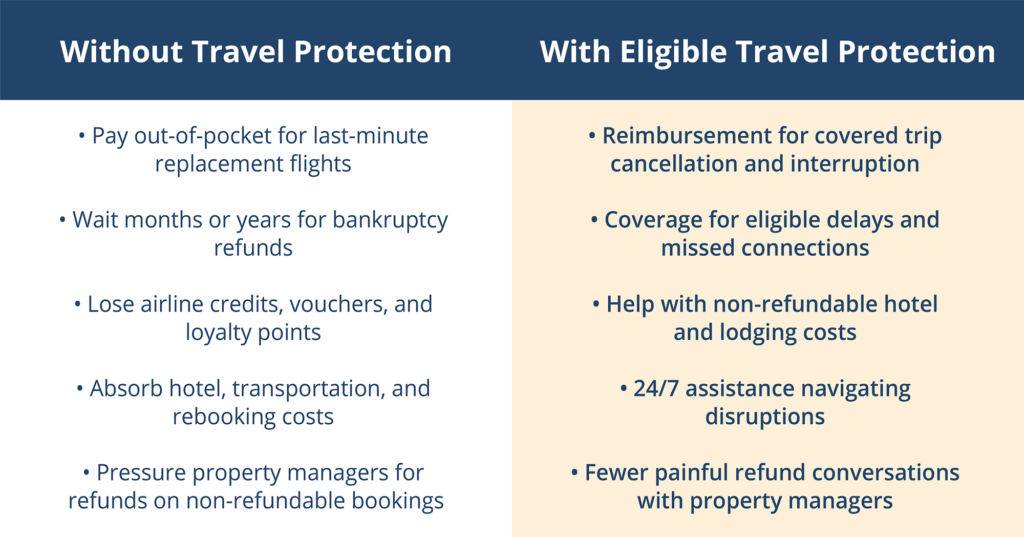
With vs. Without Travel Protection: The Guest Experience
Two guests can book the same Spirit flight and end up with very different outcomes. It comes down to whether they had protection in place before the shutdown was announced.
When Travel Insurance Isn’t Enough: Meet Booking Guardian
Travel protection pays the guest. But what about the operator and the homeowner left holding a canceled booking when guest insurance doesn’t apply or when there’s no policy at all? That’s where Booking Guardian comes in. Where Travel Guardian reimburses the traveler, Booking Guardian, currently available to Streamline VRS users, reimburses property managers.
Booking Guardian is a cancellation revenue protection product built specifically for property managers. It covers eligible guest cancellations that occur between roughly 60 and 3 days before check-in, exactly the window where last-minute disruptions like an airline shutdown hit hardest so you can offer the flexible cancellation policies guests want without absorbing the revenue hit yourself. Operators get paid, homeowners get paid, and difficult refund conversations get a lot shorter. Learn more on the Booking Guardian product page.
Why Vacation Rental Managers Choose RentalGuardian
RentalGuardian was built for one industry: vacation rentals. That focus shows up in every part of the platform, from the integrations that drop protection into your existing booking flow, to the underwriting that recognizes how short-term rental trips actually work.
With RentalGuardian, property managers can:
- Offer Travel Guardian protection with one of the broadest coverages in the global travel insurance industry.
- Cover 30+ reasons for trip cancellation, interruption, and delay reimbursing up to 100% of eligible non-refundable, non-airfare costs (airline tickets and airfare are not reimbursed).
- Add Cancel For Any Reason (CFAR) flexibility that research shows can lift bookings 10–20%.
- Integrate via API with most major vacation rental software systems so protection is offered automatically at booking.
- Reduce difficult, case-by-case refund conversations when events outside your control disrupt guest travel.
- Protect booking revenue (yours and your owners’) when disruptions would otherwise create exception-refund pressure.
Learn more on the Travel Guardian product page.
The Bottom Line: Why Travel Protection Has to Come First
The Spirit Airlines shutdown is the kind of headline event that surprises everyone except the underwriters. Airlines fail. Weather hits. Guests get sick. The question is never whether disruption will happen… it is whether your guests are protected when it does, and whether your business is positioned to respond without absorbing the cost.
For property managers, the lesson is straightforward: protection has to be in front of the guest before the news breaks, not after. Offering Travel Guardian at the point of booking turns a stressful, confrontational moment into one where you can confidently point guests to a path forward and keep your revenue, your owners, and your reviews intact.
Protect Your Guests. Protect Your Revenue. Partner with RentalGuardian
Unexpected travel disruptions aren’t slowing down. The operators who handle them best are the ones who built protection into their booking flow before they needed it. See how RentalGuardian can do that for you.
→ Schedule a RentalGuardian Demo
→ Explore RentalGuardian Products
Travel Guardian travel protection plans do not reimburse airline tickets, airfare, or airline-related fees. Coverage descriptions in this article are summary in nature. All benefits are subject to the terms, conditions, exclusions, and limitations of the plan and the traveler’s state of residence. Only licensed insurance agents can evaluate the adequacy of coverage for an individual situation.