
by April Sarver | Sep 16, 2026 | Uncategorized
What “just this once” is really costing your vacation rental business.
Guest Refund Requests Always Start with a Phone Call
A guest calls three days before arrival. There has been a family emergency, the trip is off, and they are well outside the cancellation window. They are polite. The story is real. They ask for a full refund.
Your reservations agent wants to help. They are outside of their cancellation window. Someone has to make a call and, whichever way it goes, someone ends the conversation unhappy.
For most vacation rental operators, this is no longer an occasional edge case. Guest refund requests have become a weekly line of work, and handling them one at a time costs far more than the refunds themselves.
The Visible Cost: A Booking You Probably Cannot Replace
The obvious cost is the money that leaves the account. What is less obvious is how hard that money is to replace once it is gone.
Booking windows have compressed. Guests commit later, shop harder, and choose the listing that gives them a way out. A cancellation released back to the calendar seventy-two hours before check-in is competing against every other last-minute vacancy in the market, usually on price. Even when the dates do refill, they often refill lower, and the difference never shows up on a report as a loss. It simply shows up as a smaller month.
In peak season the math gets sharper. A single late cancellation on a premium week can erase the margin earned on several clean stays, which is exactly the exposure revenue leaders are being asked to explain.
Wondering how other operators keep these decisions off their reservations team? Explore your options.
The Hidden Cost: Hours for Which Nobody Invoices
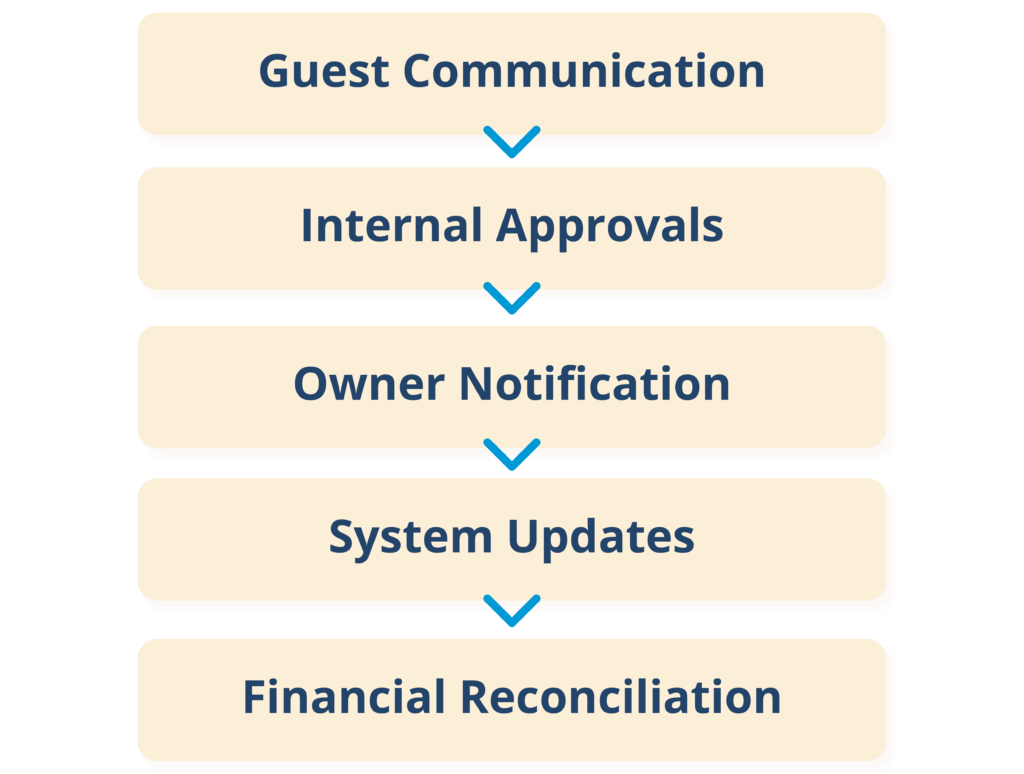
A guest refund request almost never ends with a single email. One exception typically travels through:
- Two or three rounds of guest messages, often emotional and rarely quick
- An internal approval, because the agent cannot authorize the exception alone
- A homeowner notification, which is its own conversation
- Reservation, rate, and channel adjustments so the calendar reflects reality
- Accounting reconciliation, trust accounting included, before the month closes
What looked like a five-minute decision consumes hours of skilled labor, spread across the people you least want pulled off revenue-generating work. Multiply that by the number of exceptions your team fields in a season and the staffing cost of your cancellation policy becomes visible for the first time.
There is a morale cost underneath it. Teams that spend their week negotiating refunds stop feeling like hosts and start feeling like a claims department.
Caught Between the Guest Satisfaction and a Cancellation policy.
Every refund decision asks a property manager to serve two people whose interests point in opposite directions. Owners expect policies to be enforced and income to be defended. Guests expect empathy, flexibility, and a human response to a genuinely bad week. Handled badly, a single exception damages both relationships at once: the owner sees a manager who gave away their revenue, and the guest still leaves a three-star review about how long the decision took.
Most teams end up improvising a middle path. Partial refunds. Credits for a future stay. Fee waivers that quietly come out of management revenue rather than owner revenue. None of it is written down, which means the policy your business actually runs on is whoever answered the phone that day.
“The policy your business actually runs on is whoever answered the phone that day.”

What Guest Behavior Is Telling You
The pressure behind these guest refund requests is not a customer service problem. It is a market signal, the numbers are consistent, and here’s what it means for your calendar:
- 75% of travelers prefer flexible cancellation when deciding where to book ~Expedia Group Research
- 3x higher conversion on listings that carry flexible cancellation policies ~Airbnb Partner Data
- +30% ADR uplift reported on OTA listings offering flexible cancellation ~Operator Data
- 30% fuller booking calendars where flexible policies are in place ~ VRNation Owner Retention Panel, 2025
Curious how your own cancellation strategy measures up against those numbers? Explore your options.
Guests are not asking for exceptions because your policy is unclear. They are asking because the rest of the travel market, hotels and airlines included, has trained them to expect a way out. A strict policy does not stop that expectation. It just moves the conversation from the booking page to your phone line, three days before arrival.
Building a Better Default
The goal is not to deny legitimate guest hardship. It is to stop making every hard week a three-way trade between guest satisfaction, owner satisfaction, and revenue. That starts with three practical moves.
- Write down the exception rule you are already following. If your team grants partial refunds at a certain threshold, make it policy, publish it internally, and let agents resolve those cases without an approval chain. Undocumented discretion is what turns a ten-minute case into a three-day one.
- Track what exceptions actually cost. Log every refund request with the reason, the dollar value, whether the dates refilled, and roughly how much staff time it consumed. Within one season you will have the number that ends the debate about whether your cancellation strategy is working.
- Move the risk off the relationship. This is where cancellation protection changes the shape of the problem. When coverage is attached to the reservation at the time of booking, a covered cancellation is no longer a negotiation between a manager, a guest, and an owner. It is a defined outcome everyone agreed to up front.
That is the premise behind Booking Guardian from RentalGuardian.com by Inhabit. Coverage attaches automatically to qualifying reservations through a native integration with your reservation platform, so there is no manual step for your team. When a covered guest cancels, Booking Guardian pays your property management company directly, which keeps the owner statement whole and the forward revenue picture predictable. Booking Guardian+ extends eligible cancellation coverage from 60 days out to 3 days before check-in, and deductibles may be waived when a replacement reservation meets qualifying rebooking thresholds.
The practical effect is not that refunds disappear. It is that the refund conversation stops being a judgment call your team has to win.
If protecting the booking sounds better than debating it, explore your options with the RentalGuardian team.
The True Price of “Just This Once”
Guest refund requests are not only financial decisions. They are operational decisions, relationship decisions, and, eventually, owner retention decisions. Each one spends money, hours, and trust, and only the first of those three ever appears on a report.
The operators pulling ahead right now are not simply reacting faster. They have decided in advance what happens when plans change, so their teams are not improvising, their owners are not surprised, and their guests are not made to plead. That is the difference between managing exceptions and having a strategy.
Because the real cost of “just this once” is almost never just the refund.
How Often Does Your Team Face a Guest Refund Request that Puts Guest Satisfaction and Revenue Protection on Opposite Sides of the Table?
The most resilient vacation rental businesses are answering that question before the phone rings. If you want to see how cancellation protection could fit your portfolio and your policy structure, the RentalGuardian team will walk through it with you.
Explore Your Options
RentalGuardian.com is an online service and support distribution platform, and is not a licensed insurance agency, nor does it represent or sell insurance. Coverage is subject to policy terms, conditions, limitations, exclusions, eligibility requirements, and claim approval. Products are offered by InsureStays (dba of Sandhills Insurance Group) via the RentalGuardian.com software distribution platform. California License No. 0M14453; Texas License Nos. 2194106 and 2205876.

by April Sarver | Sep 8, 2026 | Uncategorized
Most property managers think of guest and damage protection as a safety net, something that only matters when something goes wrong. The operators pulling ahead treat it as a strategy. Done right, protection does more than cover the worst case: it delights guests, retains owners, and grows revenue at the same time.
That was the throughline of “Turning Protection Into a Strategic Advantage,” a webinar from RentalGuardian in partnership with Streamline by Inhabit. Bob Clouser, Emily Cummings, and Olivia White broke down how the right mix of coverage fits naturally into the way you already run your business. Here’s the recap.
Why Protection Is a Strategic Advantage
The value of protection shows up in three places at once. When they work together, a single set of programs strengthens every relationship in your business.
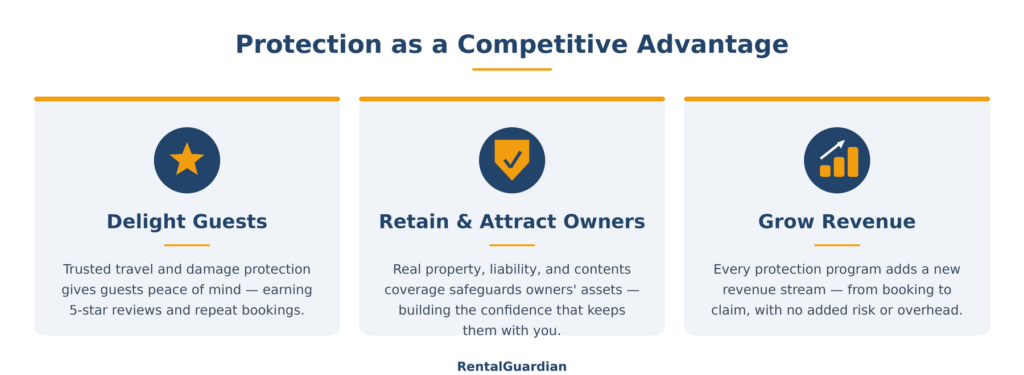
Delight guests. Travelers want peace of mind that an honest accident won’t derail their trip or their budget. When protection is in place, an unexpected cancellation or a cracked countertop becomes a manageable moment instead of a dispute, the kind of experience that earns good reviews and repeat bookings.
Retain and attract owners. Owners want to know their income and their property are protected. Clear coverage for damage, liability, and cancellations means fewer awkward conversations, fewer self-funded repairs, and more confidence to keep their listings with you, and to add more.
Grow revenue. Every protection program is also a revenue stream. With the right coverage mix, you insulate booking income and add margin without taking on the risk yourself.
Three Connected Solutions
RentalGuardian focuses on three areas that map to the moments where property managers are most exposed.
Booking Guardian: Flexible Cancellation
Booking Guardian lays a flexible-cancellation insurance program across your bookings. When a guest cancels (anywhere from 60 days out to as few as 3 days before arrival, depending on the program), the booking value is protected instead of lost. You can offer a more flexible policy without absorbing the risk yourself.
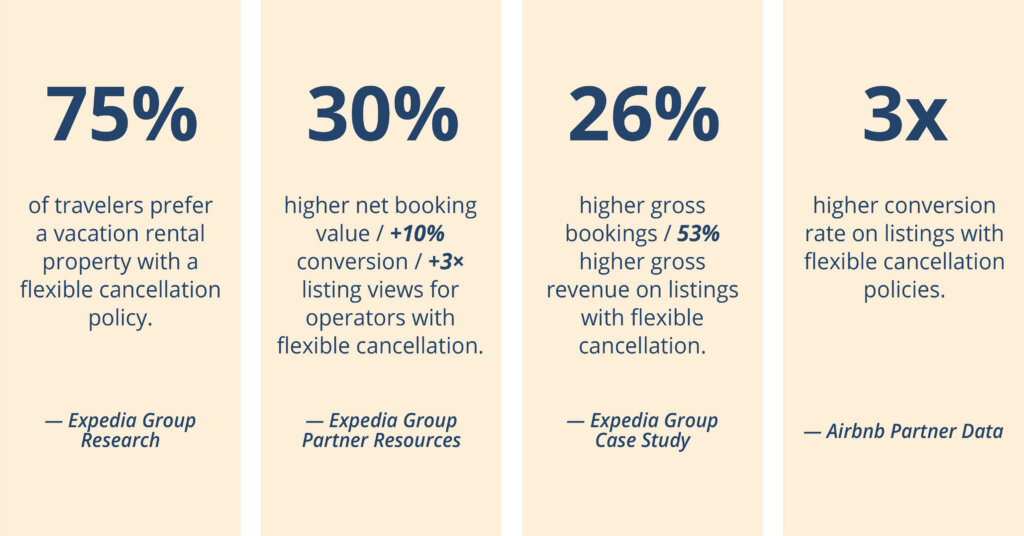
Flexibility isn’t just a nicety; it moves the numbers. According to studies cited in the session from Expedia Group and Airbnb, 75% of travelers prefer a flexible cancellation option, listings that offer one see about 30% higher booking value and a 26% increase in gross bookings, and flexible listings can convert up to 3× better.
Travel Guardian and Cancel for Any Reason
Travel Guardian is guest-facing travel protection covering more than 30 trip cancellation and interruption reasons, reimbursing up to 100% of non-refundable costs, one of the broadest coverages in the travel industry. Adding Cancel for Any Reason (CFAR) extends that protection beyond the standard list to virtually any reason a guest needs to cancel, reimbursing up to 60% of non-refundable costs.
Demand is already there: in a 2026 survey, 28% of US travelers said they plan to purchase travel insurance. If you don’t offer it, they’ll buy it elsewhere, and you’ll miss both the guest service and the revenue.
Home Guardian: Damage Protection
Home Guardian is damage protection built for vacation rentals, and the difference is in the fine print. RentalGuardian pays full replacement cost rather than actual cash value, so an owner can replace a years-old TV or a cracked granite countertop with a like-for-like item, without fighting over depreciation.
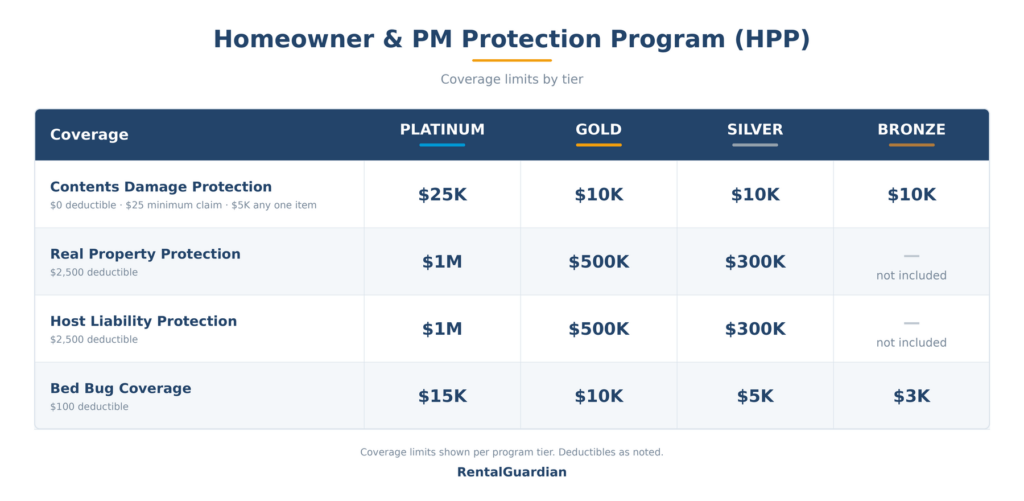
Coverage comes in tiers, from a Bronze base package up to Platinum, which includes $25,000 in contents coverage, $1 million in real property protection, $1 million in host liability, and $15,000 in bed bug remediation. And because there’s no guest-verification requirement, an honest accident stays an honest accident, not a standoff over who admits fault.
Where Protection Fits in the Guest Journey
Great coverage only works if guests actually see it. The most successful programs use several touchpoints rather than relying on any single one.
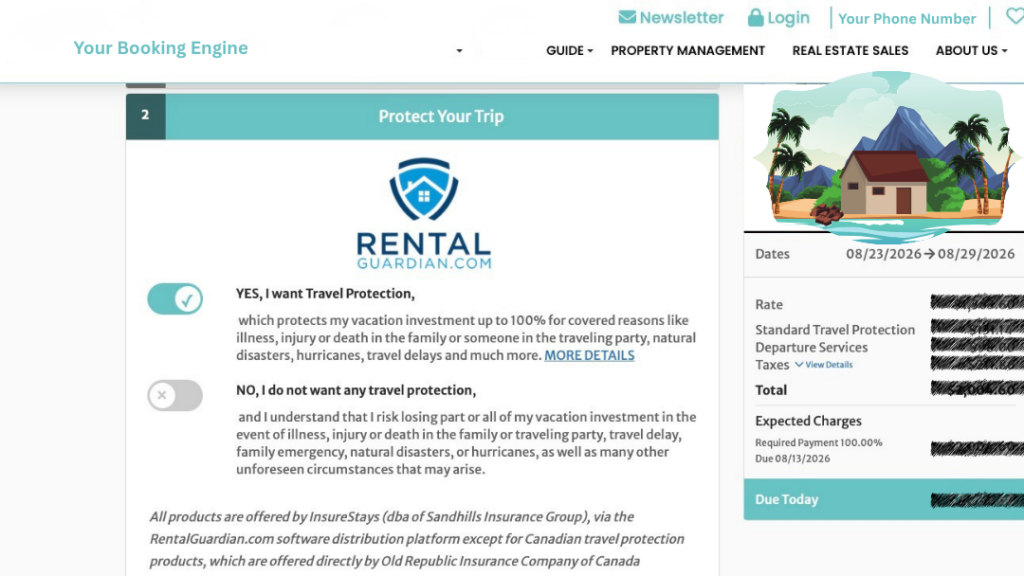
Start with your direct booking website. A simple travel-insurance tab or dropdown gives guests an easy place to find and reference the program and gives your team an easy resource when questions come up. The highest-impact touchpoint is the booking path itself: with Streamline, protection is presented directly in the checkout flow, a natural moment for guests to consider it while they reserve.
From there, a branded microsite lets guests review options, manage coverage, and access policy information on their own, whenever they need it. Your team doesn’t need to become insurance experts. RentalGuardian provides the training, talking points, and marketing support, and every partner gets a dedicated account manager to guide setup, launch, and everything after.
The Bottom Line
Protection is one of the few decisions that can work for your guests, your owners, and your bottom line at the same time. The key is positioning it inside the guest experience and the owner conversations you’re already having, so it stops being a cost of doing business and becomes one of your strongest competitive advantages.
Keep the Conversation Going
Ready to talk through which solutions fit your portfolio? Our team is here to help you build the right protection strategy.
LET’S TALK

by April Sarver | Aug 12, 2026 | Uncategorized
Commercial insurance purpose built for short-term rentals.
Ask ten vacation rental operators what insurance they carry and most will describe a homeowner’s policy with a short-term rental endorsement bolted onto it. That arrangement holds up fine until the day it doesn’t: a cleaner is hurt during a same-day turnover, a booking platform breach exposes guest payment data, or a maintenance van clips a parked car on the way to a burst-pipe call.
Once you have staff, vehicles, software, contractors and dozens of doors under management, you are no longer insuring a house. You are insuring a company that happens to operate houses. Commercial Lines, offered in partnership with ePremium and RentalGuardian, was built to close exactly that gap: comprehensive commercial coverage paired with year-round risk management designed to strengthen your business and position it favorably at renewal.
Why Standard Commercial Insurance Doesn’t Fit Short-Term Rentals
 Most commercial policies treat a short-term rental company like any other small business. The exposures are not the same. Your revenue depends on strangers holding keys to properties you do not live in, on cleaners and contractors moving through those homes in tight windows, and on a software stack that stores guest identities, card data, and door codes. One bad weekend can produce a liability claim, a workers’ compensation claim and a cyber incident from the same set of facts.
Underwriters notice that. Operators who cannot show inspections, screening procedures, written policies or documented training tend to get priced as unknowns. Operators who can show that work tend to get priced as managed risk. The difference between those two positions compounds every renewal cycle, and it is the strongest argument for a commercial program built specifically for this industry.
Eight Coverage Lines, Written for the Way You Operate
The program covers eight lines, so there are fewer seams between policies and the gaps are easier to spot before a claim finds them.
| Coverage line |
Where it earns its keep in a short-term rental operation |
| General Liability |
Guest and third-party bodily injury or property damage arising from your operations and the homes you manage. |
| Workers’ Compensation |
Cleaners, maintenance techs and in-house staff injured on the job, including the turnover work that drives most of your labor hours. |
| Business Auto |
Company and staff vehicles running turnovers, supply runs and emergency maintenance calls. |
| Property |
The buildings, offices, storage units, and supply depots your business owns or occupies. |
| Business Personal Property |
Linens, furnishings, tools, appliances, and inventory held for the properties you manage. |
| Cyber |
Breaches involving guest data, booking systems, smart-lock platforms, and the payment information you handle. |
| Professional Liability |
Claims arising from the management services you provide to owners, from listing and pricing decisions to accounting and reporting. |
| Excess Liability |
Additional limits above your primary policies when one severe loss would otherwise exhaust them. |
Writing these lines together does more than simplify your certificate binder. It gives one advisor visibility across your entire risk picture, which is how gaps get caught during a review instead of during a claim.
The Best Claim Is the One You Never Have to File
The part operators tend to underestimate is what comes attached to the policy. Every commercial policy includes a built-in risk mitigation program: the plans, training, and protections that stop losses before they start. It is not an add-on product or a paid upgrade. It is value built into the coverage, and it is organized around four areas.
Cybersecurity and incident response
You get an information systems security policy covering baseline controls, data classification, and retention; a laptop and mobile security policy setting encryption, password and remote-wipe standards; and a formal incident response plan that names roles, communications, containment and recovery steps. Penetration testing and vulnerability scans arrive with prioritized findings and a remediation roadmap. Annual cyber awareness training includes phishing simulations and staff education. If a breach does happen, you get a breach playbook plus on-demand technical and legal triage.
People and employment risk controls
Employment claims are quieter than guest injuries and often more expensive. The program includes an employment practices toolkit with handbook and policy templates, harassment prevention and HR training paired with a legal helpline, background screening and anonymous reporting to reduce insider risk, and workplace violence prevention checklists with response referrals.
Technical controls and assessments
A network and system audit brings vulnerability scanning and log review. Secure configuration guidance covers the wi-fi, routers and IoT devices sitting in every unit you manage, including the smart locks, thermostats, and cameras that make modern operations efficient and also widen your attack surface. Documentation and evidence retention guidance keeps your record keeping claim-ready, which matters enormously on the day you need to prove what happened.
Property, operations and casualty
Property inspections and loss control surveys identify hazards and produce a written mitigation plan. Physical security assessments review lighting, access control, and camera placement. A vendor and contractor safety program handles insurance verification and contract clauses so a subcontractor’s mistake does not land on your policy. Tenant safety for short-term rentals covers what is unique to this industry: guest screening, emergency procedures, and signage.
How It Works: Assess, Mitigate, Respond
The program runs on a three-step cycle rather than a binder that sits on a shelf.
Assess. Inspections, audits and security assessments pinpoint your actual exposures instead of assumed ones.
Mitigate. Policies, training and playbooks close the gaps before a loss occurs.
Respond. Incident response and preferred vendors speed your recovery when something happens anyway.
What Arrives in Your Insurance Packet
This is where the program separates itself from a generic resources page. Your packet includes:
- A written incident response plan
- Laptop and information systems policy templates
- A penetration test schedule or report with a remediation summary
- An annual cyber awareness training schedule and completion proof
- An employment practices summary with hotline information
- A property inspection summary with an action list
- A preferred vendor list and post-loss contact sheet
Those documents do double duty. They reduce the chance of a loss, and they are exactly the evidence an underwriter wants to see when your renewal comes up.
Value Adds That Work Before and After a Loss
Three insurance-linked benefits round out the program. Policy-linked playbooks give you tailored response plans for your general liability, property, workers’ compensation, and errors and omissions exposures. Post-loss support connects you to preferred forensic IT, legal, and restoration vendors the moment a claim hits, so you are not sourcing a restoration firm at eleven at night. Co-funded remediation provides partial reimbursement for qualifying cyber or safety work, which lowers the cost of fixing a problem you already know about.
The combined effect is straightforward. Fewer losses, faster recovery, safer guests, and less of your time and budget spent on insurance so both can go back into the portfolio.
Backed by Industry-Leading Carriers and Partners
The program is supported by AmTrust Financial, Arlington/Roe, Ryan Turner Specialty, and LocalEdge, part of Bridge Specialty Group. Alongside the coverage lines, the agency provides OSHA compliance guidance, best hiring practices, and drug and safety protocols as part of a year-round risk management partnership.
Frequently Asked Questions
Do I need commercial insurance if I only manage a handful of short-term rentals?
It depends less on door count than on how you operate. If you employ or contract cleaners and maintenance staff, drive vehicles for the business, handle owner funds, or store guest data in a booking system, you have commercial exposures that a personal policy with a short-term rental endorsement was never written to cover.
Download our Commercial Lines flyer.
Is the risk mitigation program an extra cost?
No. It is built into the commercial coverage. The inspections, policy templates, training and response plans described above come with the policy rather than as a separately priced service.
Download our Risk Mitigation flyer.
Is the program available in my state?
Commercial Lines in partnership with RentalGuardian and ePremium is available in all 50 states.
How does any of this help at renewal?
Documented controls change how underwriters see you. Completed inspections, a written incident response plan, penetration test results, training completion records and a vendor safety program give an underwriter concrete evidence that your operation is actively managed, which supports better positioning when your policies come up for renewal.
Build It into Your Next Renewal
Don’t just insure the risk. Reduce it. If your current program was assembled policy by policy as your portfolio grew, a single review with a commercial risk advisor who works in short-term rentals will usually surface gaps you did not know you had.
START THE CONVERSATION

by April Sarver | Jul 13, 2026 | Uncategorized
The flexibility dilemma is over. For years, vacation rental operators have been forced to choose between two things they can’t afford to sacrifice. That choice no longer exists.
There’s a tension that lives at the center of every vacation rental operation, and most property managers know it by heart.
Travelers want flexible cancellation policies. Owners want predictable income. Operators want both and until now, they’ve largely been told to pick one.
That’s the flexibility paradox. And it’s been quietly costing the industry billions in lost bookings, eroded owner trust, and competitive positioning that lags further behind hotels every season.
Today, that dilemma ends. Booking Guardian — reimagined — is here, and it is available in two configurations, so operators can match the program to their portfolio to maximize revenue.
The Market Shifted: Why Flexible Cancellation Policies Now Drive Vacation Rental Revenue
Flexible cancellation used to be a guest experience feature. A nice-to-have. Something hotels offered and vacation rentals apologized for not matching.
That era is over. The data is unambiguous:
|
75%
of travelers prefer a vacation rental property with a flexible cancellation policy.
|
30%
higher net booking value / +10% conversion / +3× listing views for operators with flexible cancellation.
|
26%
higher gross bookings / 53% higher gross revenue on listings with flexible cancellation.
|
3x
Higher conversion rate on listings with flexible cancellation policies.
|
|
— Expedia Group Research
|
— Expedia Group Partner Resources
|
— Expedia Group Case Study
|
— Airbnb Partner Data
|
Sources: Expedia Group Research; Expedia Group Partner Resources; Expedia Group Case Study Airbnb Partner Data
Booking windows are compressing under economic pressure. Guests commit later than ever and when they do commit, they’re choosing the option that gives them a way out. Strict cancellation policies don’t protect revenue anymore. They redirect it to someone else’s calendar.
The market shifted. The cancellation strategy has to shift with it.
What Booking Guardian Does—Revenue Protection Built for Property Managers
Booking Guardian is a revenue protection product built specifically for vacation rental companies and the professional property managers who run them.
The premise is simple: you should be able to offer the cancellation policies travelers demand and OTAs reward, without absorbing the financial exposure when plans change.
When a covered guest cancels, Booking Guardian pays the property management company directly. Your owner’s statement stays whole. Your forward revenue stays predictable. Your calendar stays competitive.
The reimagined Booking Guardian builds on that foundation with two structural advantages that set it apart from anything else in the market.
Find Out How
Learn More
1. Native PMS Integrations — Not Workarounds
Most cancellation protection products are built on improvisation. AI bots that scrape reservation data. Manual coverage entry by your reservations team. Disconnected reporting that lives outside your actual workflow.
Booking Guardian is different. It integrates natively with the platforms vacation rental companies already use, connecting directly to your PMS or reservation system, auto-attaching coverage at booking, and delivering a unified operational view without the middleware, the manual queue, or the implementation drag.
This isn’t a workaround. It’s a revenue confidence layer built into the infrastructure you already run on.

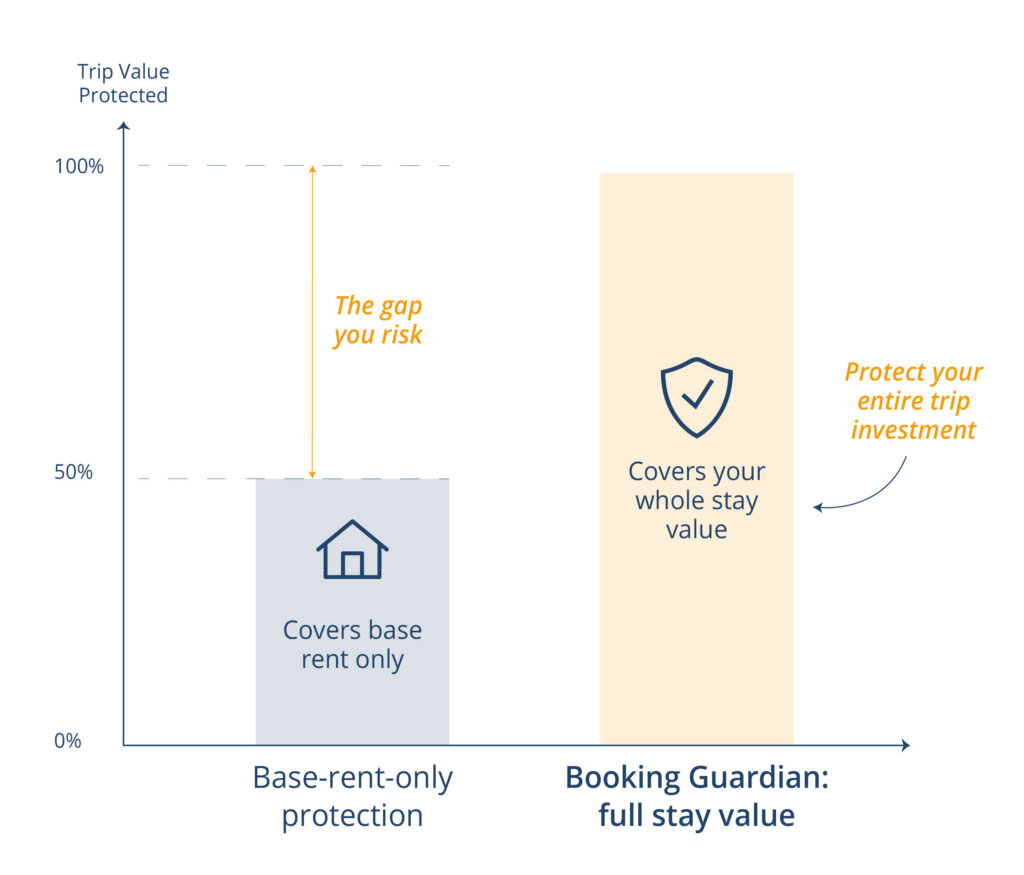
2. Full Stay Value Protection — Not Just Base Rent
Most cancellation products protect base rent. That’s not the same thing as protecting your revenue.
Booking Guardian protects the full stay value, nightly rates across the entire reservation length, qualifying fees built into the booking, and broader reservation economics that actually reflect what a cancellation costs you.
When owners see consistent forward revenue instead of refunded base rent, the retention conversation changes entirely.
Built for the People Who Run Modern Vacation Rentals
Booking Guardian was designed with three specific audiences in mind and for each one, it solves a different version of the same underlying problem.

For Property Managers, the value is competitive positioning. Flexible cancellation policies rank higher on OTAs, convert at higher rates, and attract the type of guest who books earlier and stays longer. Booking Guardian lets you publish those policies without underwriting the risk yourself.
For Owner Relations Teams, the value is the conversation that never has to happen. Owners don’t churn because of a bad month. They churn because of unpredictability because they can’t trust what next month’s statement is going to look like. Booking Guardian stabilizes forward revenue and gives your team a concrete proof point in the asset-management conversation.
For Revenue Leaders, the value is clean EBITDA optics and a defensible moat. A single late cancellation in peak season can erase the margin on three clean stays. Booking Guardian shifts that exposure off your P&L, improves cash positioning, and builds a programmatic advantage over competitors who are still handling cancellations manually.
How Booking Guardian Works: A 4-Step Cancellation Protection Flow
The four-step flow was designed with operators in mind:
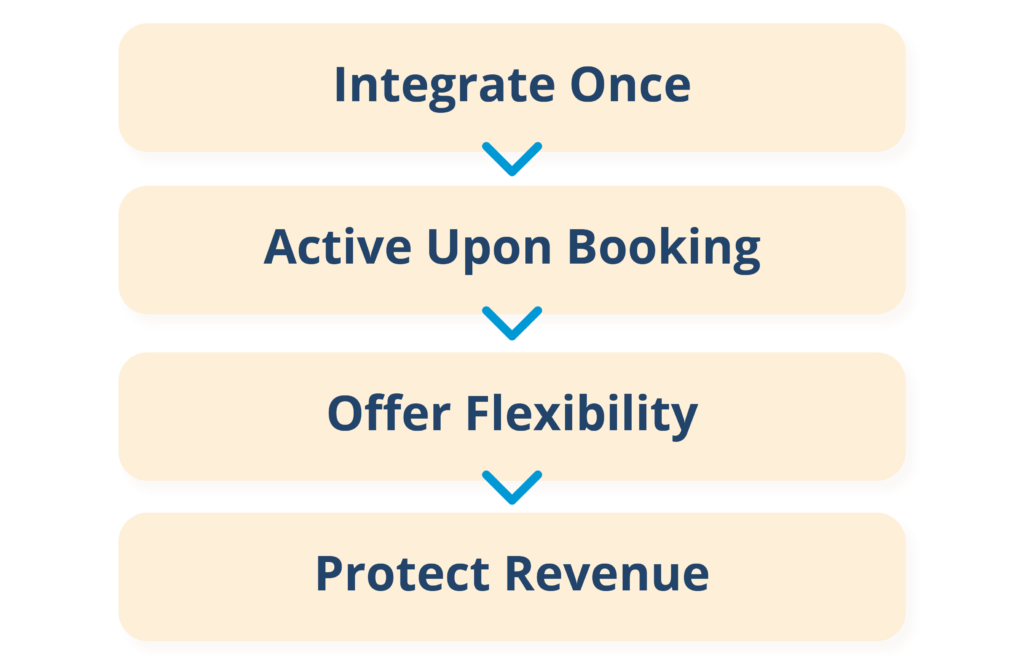
- Integrate once. Booking Guardian connects natively to your PMS or reservation platform.
- Active upon booking. Coverage attaches automatically to qualifying reservations. No manual steps for your team.
- Offer flexibility. Publish the cancellation policies guests want and OTAs reward.
- Protect revenue. When a covered cancellation occurs, the full stay value is recovered.
No bots. No middleware. No manual workflow for your reservations team. Booking Guardian is available in two configurations, Standard Window and Extended Window, so property management companies can match the program to their portfolio and policy structure. A specialist will walk through the right fit for your operation.
The Case for Acting Now
The vacation rental operators winning in today’s market have figured something out that their competitors haven’t yet: flexible cancellation and revenue protection aren’t in conflict. They’re the same strategy.
The flexible cancellation listing ranks higher, converts better, and fills faster. The covered cancellation pays out at full stay value. The owner gets a predictable statement. The property manager gets a retention story that sounds like asset management, not vendor management.
The operators still holding onto strict cancellation policies in the name of revenue protection are doing the opposite — they’re protecting against a downside scenario that Booking Guardian can handle, while sacrificing the upside that flexible policies deliver.
The market has shifted. The data backs it. The product is here. You shouldn’t have to choose between flexibility and revenue. With Booking Guardian reimagined, you don’t.
Ready to See it in Action?
Let’s Connect

by April Sarver | Jun 19, 2026 | Uncategorized
The Smokies don’t slow down. Neither does the short-term rental market surrounding them.
Pigeon Forge is one of the most resilient vacation rental destinations in the country, a market that has weathered demand swings, platform shifts, and traveler behavior changes with the kind of consistency that draws operators in and keeps them invested. But resilient doesn’t mean static. And right now, something is shifting.
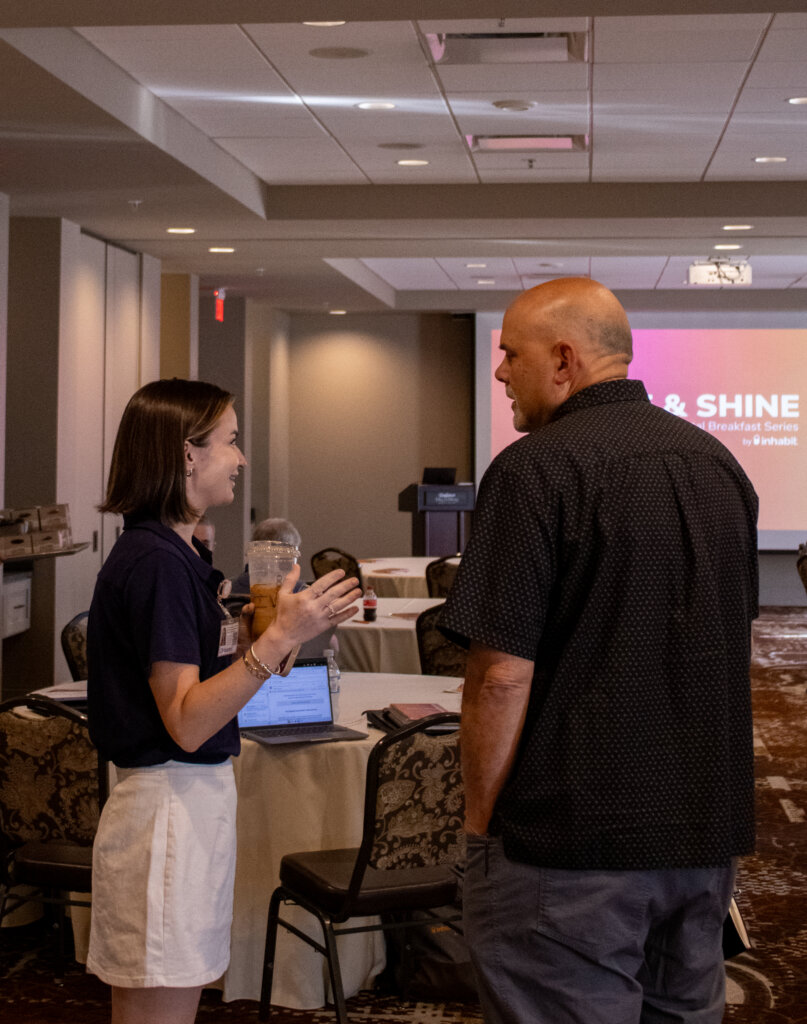
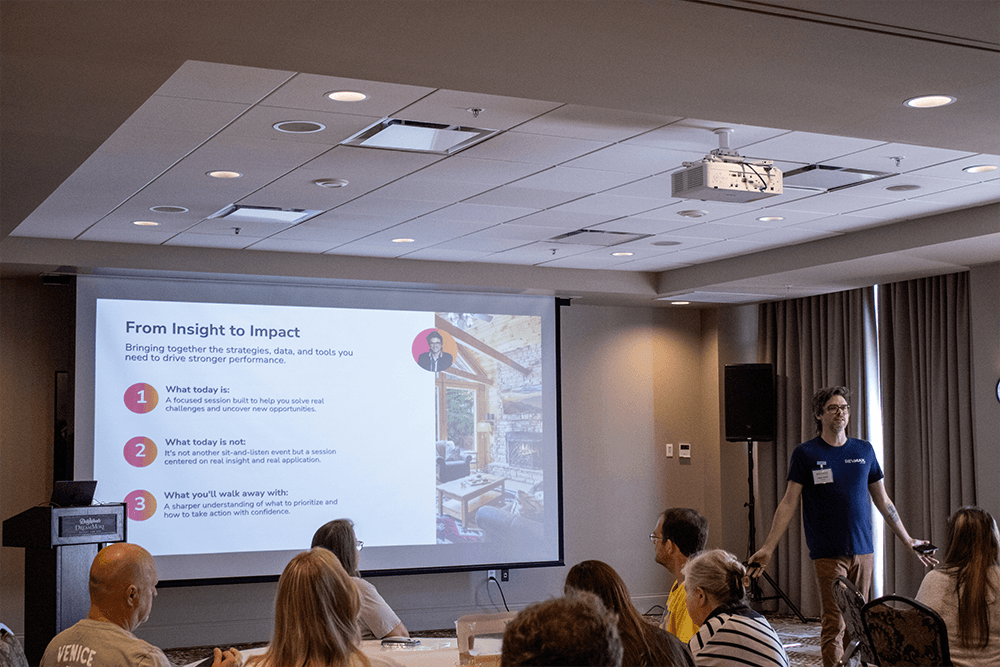
That was the undercurrent at Rise & Shine Pigeon Forge—the second stop in Inhabit’s 2026 event series—where property managers from across the Smokies region came together not to hear keynotes, but to talk through what’s actually happening on the ground.
The RentalGuardian team was there. Here’s what stood out.
The Smokies STR Market Is Changing Shape

Pigeon Forge and the surrounding Smokies corridor have long operated under a kind of gravitational pull—guests keep coming, cabins keep booking, and the market keeps absorbing new supply. But conversations at Rise & Shine revealed that the rhythm is changing.
Booking windows are compressing and expanding unpredictably. Demand patterns that operators could once count on by season are showing structural shifts, not just noise. And the pressure on direct booking channels is creating a real question about where guests are actually coming from, and—more importantly—where they’re going to look next.
What made these conversations valuable wasn’t the identification of a problem. Operators a
lready knew something was changing. It was the collective recognition that the answer isn’t to wait it out.
The operators in that room are moving. The question they brought was, “How do you move strategically instead of reactively?”
Where Guests Are Looking (It’s Not Where You Think)

One of the sharpest discussions at Rise & Shine Pigeon Forge centered on search and discovery—not rankings in the traditional sense— but the full picture of how a guest goes from “I want to go to the Smokies” to booking a specific property.
That journey has changed significantly. AI-powered search is now a real part of how travelers plan trips. Guests aren’t just typing into a search bar and scrolling results. They’re asking questions, reading AI-generated summaries, and making decisions based on content that may never include a direct link to your listing.
For STR operators, this isn’t a theoretical shift. It’s already happening. And it raises a risk that isn’t in any insurance policy: the risk of being invisible in the channels your guests are actually using.
Winning mentions and citations in AI search results requires a different approach than traditional SEO. It means having the kind of content, reviews, and digital footprint that gets referenced, not just ranked. Operators at Rise & Shine left with a clearer picture of how to build that presence without rebuilding everything from scratch.
The Cost of Reacting Too Late … or Too Fast
At RentalGuardian, we talk a lot about where risk lives in a short-term rental operation. Most operators think of risk in terms of property damage, guest incidents, or liability gaps. Those are real and important. But the riskiest position a property manager can be in heading into the back half of 2026 is operational paralysis—waiting for certainty that isn’t coming before making a move.
The flip side is equally dangerous: overhauling your entire operation in response to signals that may be seasonal rather than structural.
Rise & Shine Pigeon Forge put both failure modes on the table. The operators who are navigating this moment most effectively aren’t the ones with the biggest portfolios or the most technology. They’re the ones who have learned to distinguish between what needs to change now, what needs to be monitored, and what should stay exactly as-is.
That judgment is a skill, and it’s one that’s hard to develop in isolation. Having a room full of operators who are seeing the same signals and comparing notes is one of the fastest ways to calibrate it.
What Happened in the Room

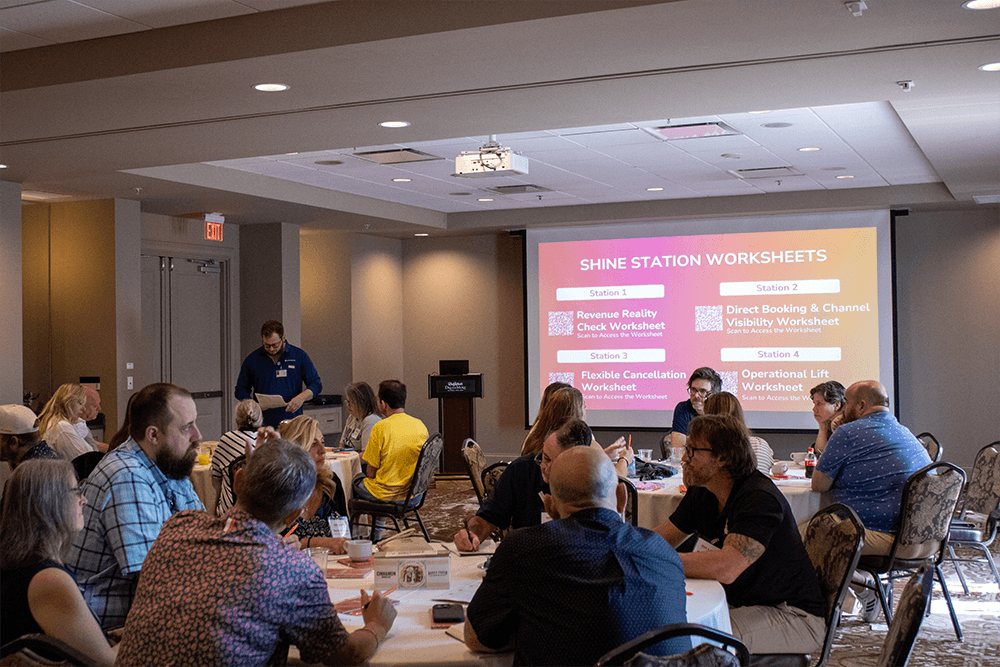
Rise & Shine was built as a working session, not a watch session. That distinction matters.
There were no vendor pitches. No polished slides designed to make a product look inevitable. Just property managers in a room with their peers, a structured agenda, and enough trust in the format to say what’s actually happening at their companies.
That environment produces something different than a trade show or a webinar. It produces honesty. People talked about what’s not working. They pushed back on conventional advice. They shared workarounds that never made it into any industry report.
The RentalGuardian team came to listen as much as to contribute. The conversations we had reinforced something we see consistently as portfolios grow: the gap between what operators think their exposure is and what it actually is tends to widen as operations scale. Not because operators aren’t paying attention, but because the complexity scales faster than the systems designed to manage it.
Hearing how operators are thinking about that complexity in real time—what they’re building, what they’re outsourcing, what they’re delaying—gives us a sharper picture of where we need to show up better as a partner.
Three Things Operators Left With
Across sessions and table conversations, a few consistent takeaways emerged:
- Understand how guests are finding you, not just how they’re booking. The discovery phase of the guest journey now includes channels that most operators aren’t measuring. Mapping that journey is the first step to showing up in the right places.
- Small, targeted changes beat operational overhauls. The operators gaining the most traction right now aren’t the ones doing the most. They’re doing fewer things with more precision. Identifying the one or two levers with the highest impact is the work.
- Know the difference between what’s in your control and what isn’t. Broader booking behavior shifts, platform algorithm changes, and AI-driven search evolution are all real. What you can control is how you prepare for them, i.e., the tightness of your operations, the depth of your guest relationships, and the coverage structures protecting what you’ve built.
That last point is where RentalGuardian lives. Not in predicting what the market will do, but in making sure that when conditions change (and they will) your operation has the foundation to absorb it.
What We’re Taking Back
 Every Rise & Shine stop teaches us something specific about the operators in that market. Pigeon Forge was a reminder that the STR operators who are built for the long haul in a market like the Smokies are already thinking several moves ahead. They’re not panicking about the shifts. They’re pressure-testing their assumptions and adjusting accordingly.
That mindset is exactly where risk management fits. It’s not a reactive measure. It’s the foundation that makes proactive decision-making possible.
We’re grateful to the operators and partners who showed up in Pigeon Forge, brought their real questions, and made the conversation worth having.
If the themes from Pigeon Forge are ones you’re navigating in your own operation—shifting demand, coverage gaps, or just figuring out where your exposure actually lives—we’d love to continue the conversation.
Connect with Rental Guardian
The Series Continues. Join Us in Breckenridge
Rise & Shine heads to Breckenridge next, with additional markets to follow.
If you’re a short-term rental operator who wants to walk away from a half-day event with a clearer picture of where your operation stands and where it needs to go, this is the event to be at.
There’s no agenda other than the one your market actually needs.
Register Your Team for Rise & Shine

by April Sarver | May 27, 2026 | Uncategorized
On May 2, 2026, Spirit Airlines went dark. After 33 years of ultra-low-cost flying, the yellow planes were grounded overnight, all flights were canceled, customer service shut down, and roughly 17,000 employees were sent home. Tens of thousands of travelers were stranded mid-trip. Millions more were left holding tickets, vouchers, and loyalty points with no clear path to recovery.
For vacation rental property managers, the fallout did not stop at the airport. Guests with canceled inbound flights started reaching out within hours. Some asking for date changes, some asking for full refunds, all of them stressed. The Spirit shutdown is more than a sad chapter in U.S. aviation. It is a live demonstration of why travel protection matters, why timing matters even more, and why vacation rental operators who offer protection at the point of booking weather these moments far better than those who do not.
TL;DR: Key Takeaways for Property Managers
- Spirit Airlines ceased operations on May 2, 2026, citing skyrocketing jet fuel prices after a $500 million federal bailout collapsed.
- Guests who paid Spirit directly with a credit or debit card are getting automatic refunds; those who booked through agents, vouchers, or Free Spirit miles face a much harder road through bankruptcy court.
- Spirit itself confirmed it will not reimburse hotels, replacement flights, or other incidental costs and pointed travelers directly to their travel insurance carriers.
- Eligible Travel Guardian plans offered through RentalGuardian may provide trip cancellation, interruption, delay, and missed connection benefits for covered, non-airfare losses tied to the shutdown, such as prepaid, non-refundable lodging. Travel Guardian does not reimburse airline tickets, airfare, or airline-related fees.
- Critical timing rule: because the Spirit shutdown is now a known (“foreseen”) event, policies issued on or after May 2, 2026 do not provide coverage related to this specific event. Encouraging guests to add protection at booking has never mattered more.
What Happened to Spirit Airlines?
Spirit Airlines announced an immediate wind-down at roughly 3:00 a.m. ET on May 2, 2026, after last-minute talks with the Trump administration on a $500 million rescue loan fell apart. CEO Dave Davis pointed to a “sudden and sustained rise in fuel prices.” Jet fuel topped $4 per gallon as the conflict in Iran disrupted tanker traffic through the Strait of Hormuz as the final blow to a balance sheet that had already absorbed two Chapter 11 filings since late 2024. The result: a Chapter 7 liquidation and the largest U.S. commercial airline failure in roughly 25 years.
Spirit’s own shutdown notice is blunt: “All flights have been cancelled, and customer service is no longer available.” For full background and refund logistics, see U.S. News & World Report and USA Today.
How Spirit Is (and Isn’t) Refunding Travelers
How a guest gets their money back depends almost entirely on how they paid. Here is the plain-English breakdown:
- Booked directly with a credit or debit card: Spirit is automatically refunding to the original form of payment. If a refund does not appear, the cardholder can file a chargeback under the Fair Credit Billing Act.
- Booked through a travel agent or OTA: Travelers must contact that third party directly. Refunds will not be automatic.
- Paid with vouchers, credits, or Free Spirit miles: These claims go through the bankruptcy court process. Recovery odds are low and timelines can stretch into months or years.
- Hotels, replacement flights, and incidental costs: Spirit has confirmed it will not reimburse these expenses and is sending travelers directly to their travel insurance carriers.
“Spirit is unfortunately not able to reimburse Guests for incidental travel costs associated with cancelled trips. If you purchased travel insurance, check with your carrier to see if these expenses may be covered under your plan.” Spirit Airlines
Several carriers stepped in with capped “rescue fares”: United (through May 16), Delta (through May 7), JetBlue (through May 8), Southwest (through May 6), Frontier (50% off through May 10), American, and Allegiant. Details and eligibility are summarized by Gate Access via Yahoo.
Why an Airline Shutdown Becomes a Vacation Rental Problem
Airline failures rarely stay at the airport. The moment a flight is canceled, the trip starts unraveling and that ripple lands squarely on the operations team waiting for a guest to arrive.
For vacation rental property managers, an event like the Spirit shutdown typically means:
- A surge of “can I cancel” and “can I move my dates” requests, often outside your stated cancellation window.
- Pressure to grant exception refunds for situations completely outside your control.
- Delayed or no-show arrivals that disrupt cleaning schedules and back-to-back bookings.
- Difficult conversations with owners about lost revenue on already-blocked dates.
- Reputation risk in reviews if guests feel “the property manager wouldn’t help.”
Operators who already offer travel protection at the point of booking have a different conversation. Instead of negotiating a refund the contract does not actually require, they can point guests to a covered claim and protect both the booking and the relationship.
Does Travel Insurance Cover an Airline Shutdown?
It can for certain covered, non-airfare costs, but the details matter. For travelers with eligible Travel Guardian protection underwritten by United States Fire Insurance Company, certain benefits may apply to covered, non-airfare losses tied to Spirit’s closure and liquidation, such as prepaid, non-refundable lodging or ground transportation. Depending on the plan and state of residence, those benefits can include:
- Trip Cancellation — reimbursement for covered prepaid, non-refundable trip costs (excluding airline tickets and airfare).
- Trip Interruption — help recovering covered, non-airfare costs when a trip is cut short for a covered reason.
- Trip Delay — reimbursement for eligible meals, lodging, and ground transportation during a covered delay (airline tickets and airfare are not reimbursed).
- Missed Connection — coverage for eligible catch-up costs (such as ground transportation or lodging) when a covered disruption causes a missed onward connection. Travel Guardian does not pay for the replacement airline ticket itself.
A note on airfare: Travel Guardian protection does not reimburse airline tickets, airfare, or airline-related fees of any kind. Spirit Airlines refunds for the ticket itself must be pursued through Spirit, the issuing card, the booking agent, or the bankruptcy court. The benefits described below apply to other covered, non-airfare trip costs, subject to the plan.
The Critical “Foreseen Event” Rule (This Is the One Travelers Miss)
Travel insurance is designed to cover the unexpected. Once an event becomes publicly known, it stops being unforeseen and policies purchased after that point generally will not cover losses tied to it.
For the Spirit shutdown, the line in the sand is May 2, 2026. Travel protection plans issued on or after that date do not provide coverage related to the Spirit Airlines shutdown specifically. Plans purchased before that date may include coverage, subject to policy terms.
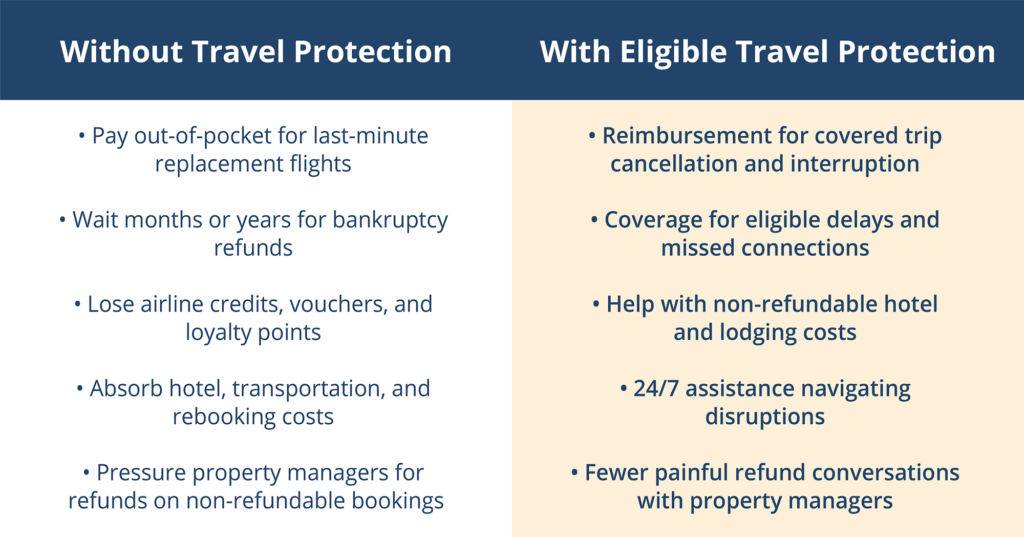
With vs. Without Travel Protection: The Guest Experience
Two guests can book the same Spirit flight and end up with very different outcomes. It comes down to whether they had protection in place before the shutdown was announced.
When Travel Insurance Isn’t Enough: Meet Booking Guardian
Travel protection pays the guest. But what about the operator and the homeowner left holding a canceled booking when guest insurance doesn’t apply or when there’s no policy at all? That’s where Booking Guardian comes in. Where Travel Guardian reimburses the traveler, Booking Guardian, currently available to Streamline VRS users, reimburses property managers.
Booking Guardian is a cancellation revenue protection product built specifically for property managers. It covers eligible guest cancellations that occur between roughly 60 and 3 days before check-in, exactly the window where last-minute disruptions like an airline shutdown hit hardest so you can offer the flexible cancellation policies guests want without absorbing the revenue hit yourself. Operators get paid, homeowners get paid, and difficult refund conversations get a lot shorter. Learn more on the Booking Guardian product page.
Why Vacation Rental Managers Choose RentalGuardian
RentalGuardian was built for one industry: vacation rentals. That focus shows up in every part of the platform, from the integrations that drop protection into your existing booking flow, to the underwriting that recognizes how short-term rental trips actually work.
With RentalGuardian, property managers can:
- Offer Travel Guardian protection with one of the broadest coverages in the global travel insurance industry.
- Cover 30+ reasons for trip cancellation, interruption, and delay reimbursing up to 100% of eligible non-refundable, non-airfare costs (airline tickets and airfare are not reimbursed).
- Add Cancel For Any Reason (CFAR) flexibility that research shows can lift bookings 10–20%.
- Integrate via API with most major vacation rental software systems so protection is offered automatically at booking.
- Reduce difficult, case-by-case refund conversations when events outside your control disrupt guest travel.
- Protect booking revenue (yours and your owners’) when disruptions would otherwise create exception-refund pressure.
Learn more on the Travel Guardian product page.
The Bottom Line: Why Travel Protection Has to Come First
The Spirit Airlines shutdown is the kind of headline event that surprises everyone except the underwriters. Airlines fail. Weather hits. Guests get sick. The question is never whether disruption will happen… it is whether your guests are protected when it does, and whether your business is positioned to respond without absorbing the cost.
For property managers, the lesson is straightforward: protection has to be in front of the guest before the news breaks, not after. Offering Travel Guardian at the point of booking turns a stressful, confrontational moment into one where you can confidently point guests to a path forward and keep your revenue, your owners, and your reviews intact.
Protect Your Guests. Protect Your Revenue. Partner with RentalGuardian
Unexpected travel disruptions aren’t slowing down. The operators who handle them best are the ones who built protection into their booking flow before they needed it. See how RentalGuardian can do that for you.
→ Schedule a RentalGuardian Demo
→ Explore RentalGuardian Products
Travel Guardian travel protection plans do not reimburse airline tickets, airfare, or airline-related fees. Coverage descriptions in this article are summary in nature. All benefits are subject to the terms, conditions, exclusions, and limitations of the plan and the traveler’s state of residence. Only licensed insurance agents can evaluate the adequacy of coverage for an individual situation.